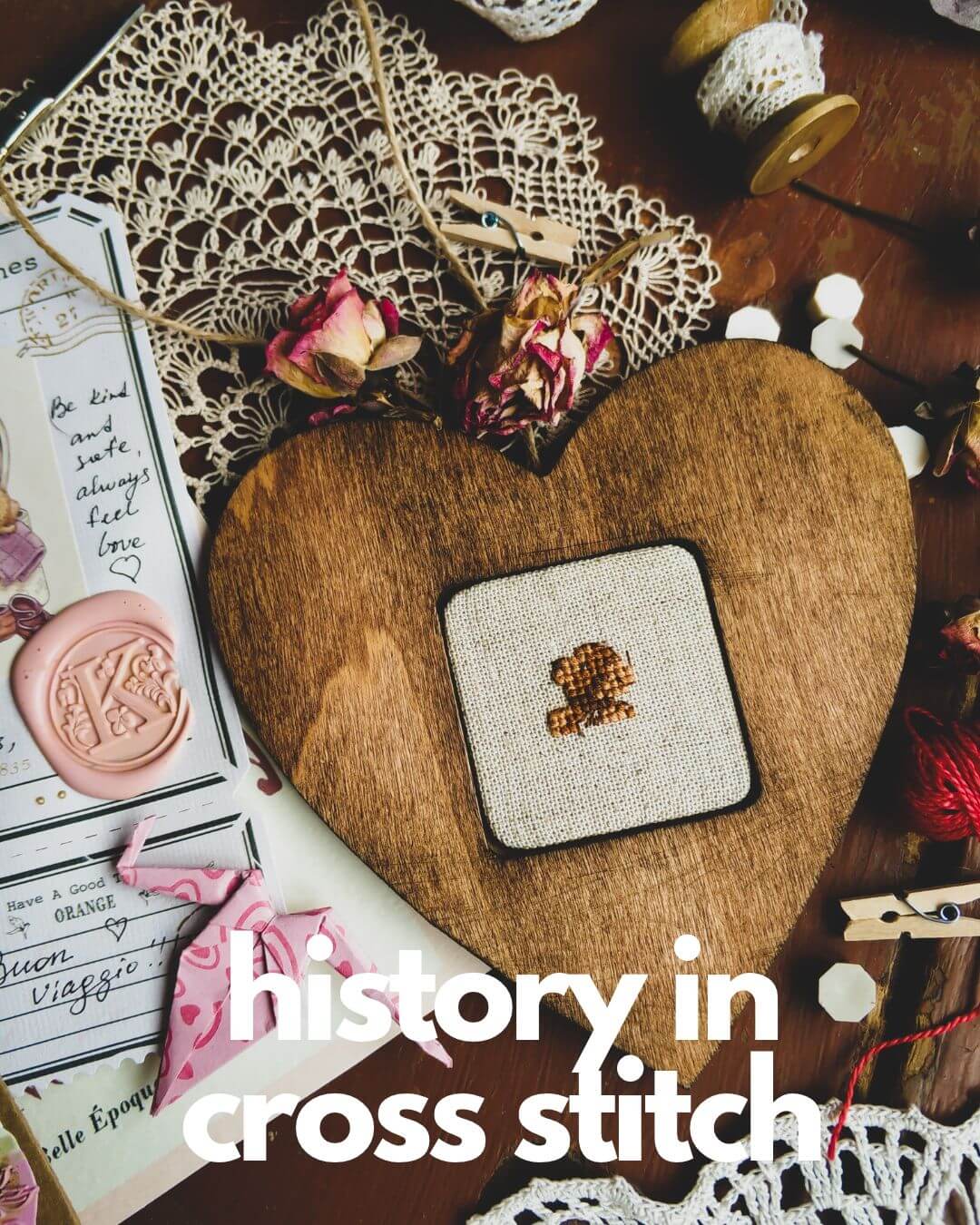
Cross stitch looks simple: one diagonal, then another on top, and you have an X. But that humble stitch has one of the longest and most well-travelled histories of any craft. It has been worked in silk by Chinese embroiderers, in linen by Egyptian weavers, in wool by Victorian ladies and in cotton by stitchers like you.
Rather than walk through every century, let’s look at the seven turning points that took cross stitch from a scrap of ancient cloth to the hobby millions of people love today.
1. The Grid Comes First
Cross stitch couldn’t exist without evenly woven fabric. Unlike freehand embroidery, it’s a counted-thread craft: you count the threads of the cloth and place each stitch in its own square. Early weavers who produced regular, countable linen created the canvas the craft needed, long before anyone thought of it as “cross stitch”.
That same principle is why choosing the right fabric still matters today. If you’re unsure where to start, The Art of Stitch has a handy guide to Aida vs evenweave and linen.
2. A Fragment From an Egyptian Tomb (c. 6th–7th Century AD)
The oldest surviving cloth known to include cross stitches was found in a Coptic burial site in Upper Egypt. The desert’s dry air kept the linen intact for well over a thousand years. It’s a small, plain piece, but it proves the X was already in use by this point.
3. Silk, Trade and the Tang Dynasty (618–907 AD)
In China, the Tang dynasty was a golden age for silk embroidery, and many historians see it as the period when cross stitch truly developed as an art. The Silk Road connected China to Persia, Arabia and Europe, and stitching techniques travelled with the merchants.
Along the way, local cultures made cross stitch their own. That’s why today you’ll find distinctive cross stitch traditions everywhere from Palestine to Ukraine to Scandinavia. Asian art remains a favourite subject for stitchers, as you’ll see in this collection of Asian cross stitch designs and the Japanese art collection.
4. Through Spain and Into the Royal Courts
Counted embroidery entered Europe through Moorish Spain, where it grew alongside blackwork, a dark-on-white counted technique. By the early 1500s it had reached England, helped along by Catherine of Aragon’s Spanish court style.
Royalty took to it. In 1502, the accounts of Queen Elizabeth of York noted linen bought “for a sampler”, the earliest written record of one. Later in the century, Mary, Queen of Scots, stitched panels in tent and cross stitch during her long captivity. Needlework had become a skill for queens as well as cottage girls.
5. The First Pattern Books (1520s)
Printing turned a local craft into an international one. In the early 1520s, Johann Schönsperger of Augsburg in Germany published one of the first printed books of embroidery patterns, and copies and imitations spread across Europe.
It’s a nice coincidence that this happened in the Germany of Albrecht Dürer, whose detailed nature studies, like The Young Hare, translate beautifully into stitches today.
6. The Sampler Becomes a Keepsake (1598 Onwards)
Early samplers were working tools: long bands of linen where a stitcher recorded borders and motifs to copy later. Over time they became something more personal.
The oldest surviving dated sampler, made by Jane Bostocke in 1598, celebrates the birth of a baby girl and is now held at the Victoria and Albert Museum. By the 1700s and 1800s, girls across Britain and America were stitching samplers with their names, ages, alphabets and verses, many of them in pure cross stitch. They’re still treasured family heirlooms, which is a big part of why cross stitch makes such a meaningful gift.
7. Berlin Woolwork and the Modern Chart (1804)
This is the moment modern cross stitch was born. In 1804, a Berlin publisher released hand-painted designs on squared paper, one square per stitch. Stitchers no longer needed to draw or copy anything. They just followed the chart.
“Berlin work” became a Victorian craze, with thousands of charts showing flowers, animals and reproductions of paintings. Two centuries later, that’s still the heart of the hobby: a coloured chart, a grid of fabric, and a picture that appears one stitch at a time. It’s exactly how today’s fine art cross stitch kits work, turning paintings by Van Gogh, Monet and Klimt into stitchable designs.
The Victorian era also had its critics. William Morris and the Arts and Crafts movement favoured original, nature-inspired designs over mass-printed charts. His patterns are still loved by stitchers, for example the William Morris bookmark designs.
Where the Story Goes Next
The 20th century brought ready-made kits, purpose-woven fabrics and a big revival in the 1960s and 70s. The 21st century brought PDF patterns, stitching apps and online communities sharing finished pieces worldwide. You can read more about how the craft is evolving in The Cross Stitch Forecast: What’s Coming in 2027.
What hasn’t changed is the X itself. The same crossed stitch found on that Egyptian fragment is the one you’ll make tonight. For a deeper dive into the craft’s surprising history, read Cross Stitch Through the Ages on The Art of Stitch blog.
Start Your Own Chapter
Whether you’re drawn to Tudor-style samplers, Victorian florals or the great masterpieces of art, there’s never been a better time to pick up a needle. If you’re just beginning, these top 10 tips for beginners will help, and the beginner cross stitch collection is a great place to find a first project.
Stitch a Piece of History
From Tudor samplers to Victorian charts, people have always stitched the art they love. Our kits turn the world’s great paintings into cross stitch, with everything you need included.

Leave a Reply