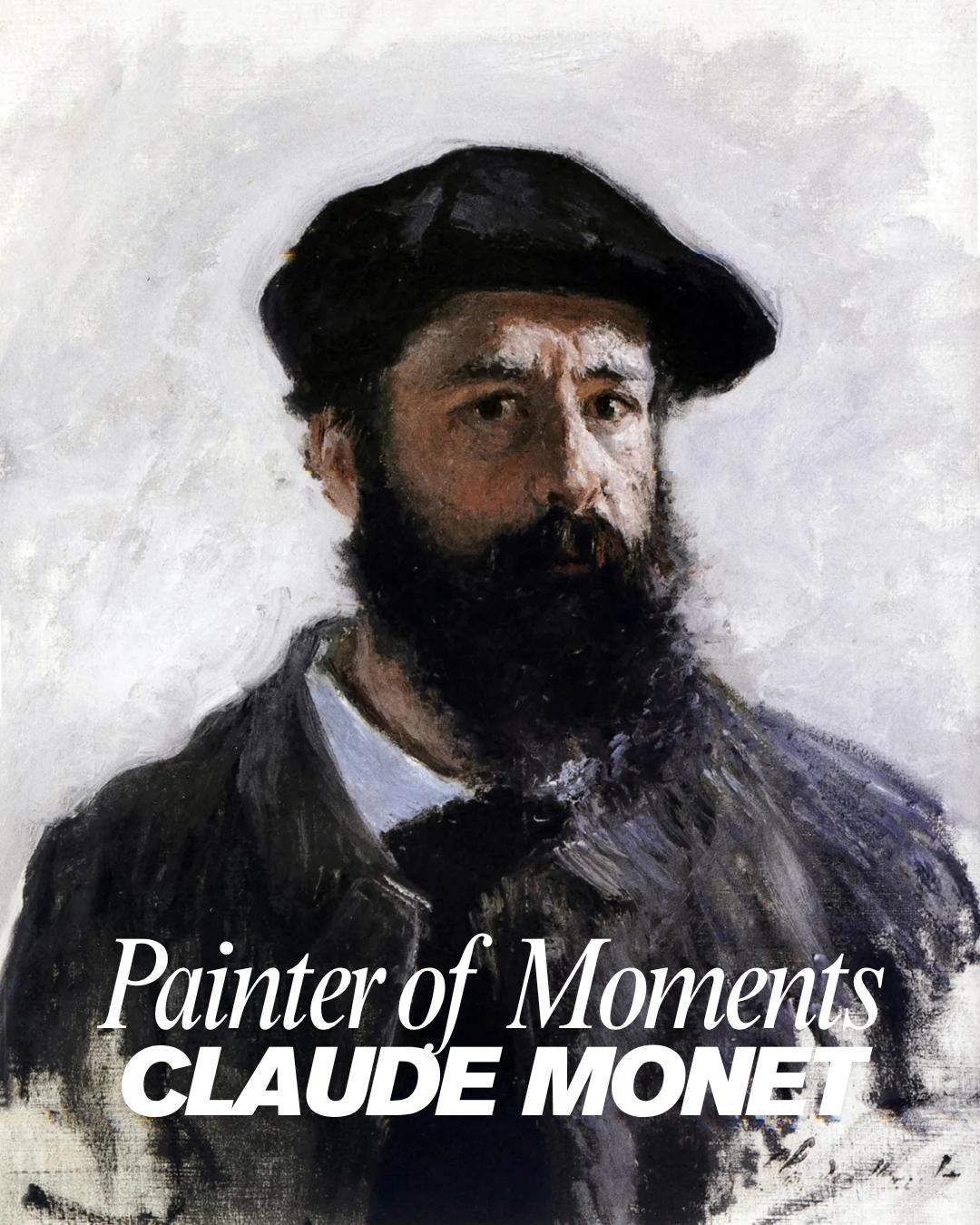
Stubborn, obsessive, and prone to dramatic tantrums, Claude Monet was also the man who changed how the world sees light. Here’s the life of a genius who destroyed his own paintings, built an impossible garden, and kept working even when he could barely see.
A Portrait of Claude Monet — As Told By Someone Who Probably Would Have Been Asked to Leave His Garden
Let me tell you something about Claude Monet: the man was impossible. Stubborn, obsessive, prone to dramatic tantrums, and utterly convinced that whatever he was working on at any given moment was a disaster. He destroyed hundreds of his own paintings. He once slashed thirty canvases with a knife before a major exhibition. His friends begged him not to. He did it anyway.
And yet — somehow, against all odds — the paintings that survived are among the most beloved in human history. Go figure.
A Normandy Boy With Big Ideas
Oscar-Claude Monet was born in Paris on November 14, 1840, but his family moved to Normandy when he was five, and that’s really where the story begins. The coast, the cliffs, the light bouncing off the water — it got into his bones early and never quite left. His whole life’s work, if you squint at it right, is basically one very long love letter to the way light hits a wet surface.
His father wanted him to take over the family grocery business. His mother died when he was sixteen. His aunt, Marie-Jeanne Lecadre, was herself an amateur painter and took the boy under her wing — which, in hindsight, was either the best or worst thing that ever happened to the Monet family grocery business.
By his late teens, Claude was selling caricatures on the streets of Le Havre. He was good at it. Charming likenesses, a bit wicked, popular enough that he was actually making decent money. He later claimed to be embarrassed by this phase. We don’t believe him.
Boudin, the Beach, and a Life-Changing Nudge
The man who arguably set Monet on his path was Eugène Boudin — a local landscape painter who dragged the teenage Monet outside to paint en plein air, meaning out in the open air rather than in a cosy studio. Monet resisted. Monet complained. And then Monet painted outside and basically never stopped.
“If I became a painter,” Monet later said of Boudin, “it is to him that I owe it.” High praise from a man who was famously stingy with it.
He moved to Paris, got into the right circles, befriended Renoir, Sisley, Bazille — the group of young painters who would eventually be sneered at by the art establishment and then, ironically, become the art establishment. He studied, he painted, he was poor, he was rejected by the official Paris Salon repeatedly, and he kept going anyway.
The Exhibition That Named a Movement (By Accident)
In 1874, Monet and his friends — fed up with the gatekeeping of the official Salon — organised their own independent exhibition. Monet showed a painting called Impression, Sunrise: a hazy, sketchy view of the port of Le Havre at dawn, all fog and orange light and a small boat you can barely make out.
A critic named Louis Leroy wrote a mocking review, using the title to coin the term “Impressionist” as an insult. Ha, he said. Impression! Not even a finished painting!
The artists said: actually, yes. That’s exactly what we are. Thank you.
And that’s how Impressionism got its name — from a man trying to be rude about it.
The Woman He Loved, and the One He Married

Monet’s first great love was Camille Doncieux, a young Parisian woman who became his model, his companion, and eventually the mother of his two sons. They were together for years before they married — partly because Monet’s father disapproved, and partly because Monet was perpetually broke and couldn’t quite sort out his affairs.
He painted Camille constantly. Woman in a Green Dress made him briefly famous. Women in the Garden got rejected by the Salon. He painted her pregnant, he painted her in the snow, he painted her walking in fields. She is in dozens of his canvases, often without anyone knowing it’s her.
When Camille died in 1879, aged just 32, from what is believed to have been cervical cancer, Monet was devastated. And then — in a moment he spent the rest of his life feeling guilty about — he found himself, almost involuntarily, studying the colours of her dying face. He grabbed a brush and painted her on her deathbed.
“I caught myself watching her tragic forehead,” he wrote to a friend, “almost automatically searching for the sequence of coloured gradations that death imposed on her motionless face.”
He was horrified by himself. But he kept the painting.
Giverny, the Garden, and the Obsession That Consumed Everything

In 1883, Monet moved to Giverny, a small village in Normandy. He rented a house, then bought it. He moved in with Alice Hoschedé — wife of a bankrupt art collector, and a woman who had been managing his household and helping raise both their combined children for years. They eventually married after her husband died in 1892. It was complicated. They made it work.
And then Monet built a garden.
Not just any garden. The garden. He hired six full-time gardeners. He had Japanese woodblock prints on his walls and used them as inspiration. He diverted a stream to create the water garden. He built the Japanese bridge. He planted weeping willows. He grew water lilies — nymphéas — in extraordinary variety.
And then he painted it. For thirty years.
He painted the lily pond in morning light, in afternoon light, in autumn, in summer, at different heights and distances. He returned to the same views obsessively, like a man trying to catch something that kept moving just out of frame. Because, of course, it was. Light never stops moving.
His neighbors weren’t always thrilled about the water garden — they worried his exotic plants would poison the stream. Monet, never one for diplomacy, basically told them to mind their business.
The Cataracts, the Crisis, and Painting Through the Dark
Around 1912, Monet noticed his vision was changing. Colours looked muddy. Outlines blurred. He was diagnosed with cataracts in both eyes, and by the mid-1910s his sight had deteriorated dramatically.
This is where another man might have stopped painting. Monet did not stop painting.
He painted by memory and by instinct, sometimes squinting at colour labels on his tubes because he couldn’t quite see the paint itself. His palette shifted — the beautiful, luminous blues of his earlier work gave way to murkier reds and yellows, the colours a cataract-damaged eye actually perceives. Some art historians can look at his late work and identify almost exactly when his vision worsened based on the colour temperature alone.
He was eventually convinced to have surgery on one eye in 1923, aged 82. It partially restored his sight. He then complained that he could see the painting he’d done during his worst years too clearly, and tried to repaint or destroy much of it.
His friends hid some of the canvases from him. Sensible of them.
The Water Lilies, and a Final Gift to France
In 1914, as the First World War broke out across France, Monet’s son Jean died, and Alice had already died in 1911. Monet was old, half-blind, grieving, and alone. He was also, characteristically, embarking on his most ambitious project yet.
He began a series of enormous, room-filling water lily paintings — Les Nymphéas — intended as a gift to France. He had a specially built studio constructed at Giverny to accommodate the giant canvases. He worked on them for over a decade.
Georges Clemenceau, the French Prime Minister and one of Monet’s oldest friends, basically bullied him into donating them to the state. Monet agreed, argued about it repeatedly, threatened to pull out, changed his mind, and eventually signed the papers the day after the Armistice in 1918. A gesture of peace.
The paintings now live in the Orangerie museum in Paris, installed in two oval rooms exactly as Monet intended — a continuous panorama of water and light that visitors walk into and are surrounded by. You don’t look at these paintings. You stand inside them.
He died on December 5, 1926, at Giverny, aged 86. He reportedly refused to have flowers at his funeral. “Flowers are for the living,” he apparently said, which is exactly the kind of thing he would say.
A Few Things You Might Not Know
Monet was a spectacular cook and took food extremely seriously. The yellow dining room at Giverny, where he hosted friends including Renoir and Cézanne, was legendary for its meals. His recipe collection still exists.
He had a rooster named after him by the villagers of Giverny. Or so the story goes. Whether the rooster was honoured or mortified is unrecorded.
He wore the same outfit almost every day in his later years: a beige linen suit, with a straw hat. He was six feet tall and had a big beard and was, by all accounts, an immediately imposing presence.
He grew over 100 varieties of iris in his garden. He ordered plants obsessively from Japan and from British nurseries. His gardening catalogues from the period survive and are, genuinely, fascinating reading if you’re into that sort of thing.
He once wrote to the Paris authorities requesting they delay the removal of poplar trees along the river Epte because he wasn’t finished painting them yet. They said yes.
Why Any of This Still Matters
The funny thing about Monet is that he spent his whole life chasing something he could never quite pin down — the exact quality of light at a particular moment, on a particular surface, in a way that made the viewer feel the air as much as see it. He failed, over and over again, at the specific thing he was attempting. And in failing — in those thousands of attempts to catch something fleeting — he made paintings that make people stop walking in museums and just stand there, quietly, not entirely sure why they feel the way they feel.
That’s the trick, isn’t it. You don’t paint what a lily pond looks like. You paint what it feels like to be there on a still morning, when the light is doing that thing it does and the water is so calm it could be the sky.
He figured that out. Took him about sixty years and a lot of destroyed canvases, but he got there.



Leave a Reply